The 7-minute rule for time clock rounding: chart and examples
What is the 7-minute rule?
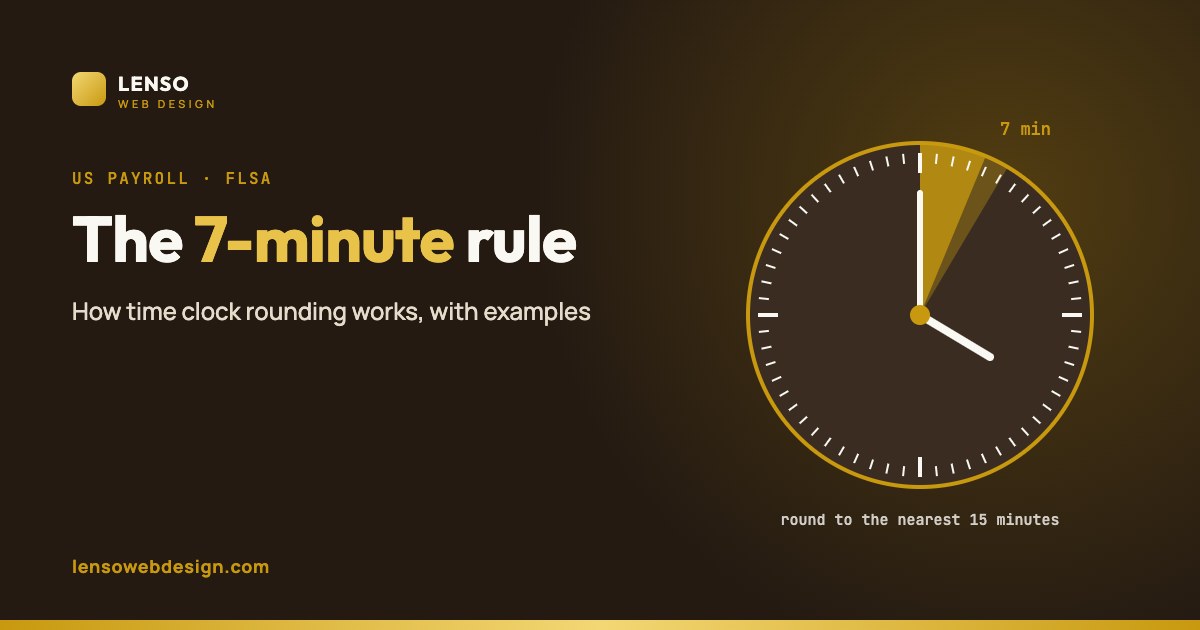
It's the common name for quarter-hour rounding. Each clock-in and clock-out moves to the nearest :00, :15, :30 or :45. Seven minutes is the halfway point of a 15-minute block, which is where the name comes from.
- 8:07 rounds down to 8:00 (7 minutes past).
- 8:08 rounds up to 8:15 (8 minutes past).
- 4:53 rounds up to 5:00 (8 minutes past 4:45).
The rule is not written in the law as "7 minutes". The law only allows rounding to the nearest 5 minutes, tenth of an hour or quarter hour. The 7-minute cut-off is simply how "nearest quarter hour" works.
7-minute rule chart
Minutes past the last quarter hour, what they round to, and the decimal hours for payroll.
| Minutes past the quarter | Rounds | Example punch | Rounded |
|---|---|---|---|
| 0 | None | 9:00 | 9:00 |
| 1–7 | Down | 9:01 to 9:07 | 9:00 |
| 8–14 | Up | 9:08 to 9:14 | 9:15 |
| 15 | None | 9:15 | 9:15 |
| 16–22 | Down | 9:16 to 9:22 | 9:15 |
| 23–29 | Up | 9:23 to 9:29 | 9:30 |
| 31–37 | Down | 9:31 to 9:37 | 9:30 |
| 38–44 | Up | 9:38 to 9:44 | 9:45 |
| 46–52 | Down | 9:46 to 9:52 | 9:45 |
| 53–59 | Up | 9:53 to 9:59 | 10:00 |
Quarter hours in decimal: :15 = 0.25, :30 = 0.50, :45 = 0.75. So 8 hours 45 minutes is 8.75 hours on the pay slip.
Is the 7-minute rule legal?
Yes under federal law, if it's neutral. The Department of Labor accepts rounding to the nearest 5 minutes, tenth or quarter hour, as long as over time it doesn't fail to pay employees for time they actually worked (29 CFR 785.48(b)).
In practice "neutral" means:
- The same rule applies to clock-ins and clock-outs.
- Sometimes it rounds in the employee's favor, sometimes in yours.
- Over weeks and months, the rounded hours are about equal to the real hours.
Some states are stricter, and California is still debating it (see below). If you're unsure, paying to the exact minute is always allowed.
Worked example: one week of rounded punches
Employee paid $20/hour, 30-minute unpaid lunch each day
| Day | Punches | Rounded | Actual | Rounded | Diff |
|---|---|---|---|---|---|
| Mon | 7:56–5:06 | 8:00–5:00 | 8:40 | 8:30 | −10 min |
| Tue | 8:09–4:58 | 8:15–5:00 | 8:19 | 8:15 | −4 min |
| Wed | 8:03–5:11 | 8:00–5:15 | 8:38 | 8:45 | +7 min |
| Thu | 7:52–5:02 | 7:45–5:00 | 8:40 | 8:45 | +5 min |
| Fri | 8:06–5:09 | 8:00–5:15 | 8:33 | 8:45 | +12 min |
| Week | 42:50 | 43:00 | +10 min |
Rounding took time off on Monday and Tuesday and added time on the other days. This week it favored the employee by 10 minutes. That back-and-forth is what a neutral policy looks like.
Pay on rounded time: 40 × $20 + 3 × $30 = $890.00.
Pay to the minute: 40 × $20 + 2.83 × $30 = $885.00.
Note that rounding comes first, then overtime. The rounded weekly total decides how many hours pass 40.
Our free time card calculator rounds each punch to the nearest 5, 6 or 15 minutes, then works out weekly overtime. No login.
Open the time card calculatorWhen rounding becomes illegal
The same five days as above, but with a one-way policy: clock-ins always round up and clock-outs always round down.
| Policy | Hours paid | Pay |
|---|---|---|
| Paid to the minute | 42:50 | $885.00 |
| 7-minute rule (nearest) | 43:00 | $890.00 |
| One-way rounding | 41:30 | $845.00 |
One-way rounding cuts 80 minutes and $40 from one week. Over a year that's about $2,080 per employee in unpaid wages, the kind of pattern wage claims are built on.
Other common problems:
- Rounding in one direction only, like the example above.
- Letting people start work before the rounded time, then rounding the punch forward. If they're working, that time counts.
- Disciplining employees for punching 1 to 7 minutes late while never paying for 1 to 7 minutes early. That breaks neutrality in practice.
- Rounding meal breaks in California (see below).
- Never checking the results. Compare rounded and actual hours every few months. If the gap always favors the business, change the policy.
5-minute and 6-minute rounding
The same law allows two smaller increments. They're closer to real time, so they are lower risk.
| Rule | Rounds down | Rounds up | Max change per punch |
|---|---|---|---|
| 5-minute (nearest 5) | 1–2 min | 3–4 min | 2 min |
| 6-minute (tenth of an hour) | 1–2 min | 3–5 min | 3 min |
| 7-minute rule (quarter hour) | 1–7 min | 8–14 min | 7 min |
Tenth-hour rounding is popular because each 6-minute block is exactly 0.1 hour, so the payroll maths is easy (8:42 worked time = 8.7 hours).
California rules
- Neutral rounding: See's Candy Shops v. Superior Court (2012) allowed it, following the federal standard.
- Meal periods: Donohue v. AMN Services (2021) held that employers can't round meal-break punches. Record meal breaks to the exact minute.
- Still open: Camp v. Home Depot asks whether rounding is allowed at all when exact punch times are recorded. It was still listed as pending before the California Supreme Court in April 2026. Check for a decision before relying on rounding.
For California employees, the safest option today is to pay to the exact minute.
Frequently asked questions
What is the 7-minute rule for clocking in?
It rounds punches to the nearest quarter hour. 1 to 7 minutes past rounds down, and 8 to 14 minutes rounds up to the next quarter.
Is the 7-minute rule legal?
Yes under federal law, if it's applied neutrally and employees are paid for all time worked over time. Some states, especially California, are stricter.
If I clock in 7 minutes late, am I paid for it?
Under quarter-hour rounding, a punch 7 minutes late rounds back to the quarter hour, so you'd be paid from the scheduled time. 8 minutes late rounds up to the next quarter.
Does the 7-minute rule apply to lunch breaks?
Federal rules don't ban it if neutral. In California, the Supreme Court held in 2021 that meal-period punches can't be rounded.
Do I have to round time at all?
No. Rounding is optional. Paying to the exact minute is always allowed and avoids neutrality disputes.
Related
- How to calculate overtime on biweekly and semi-monthly pay
- Free time card calculator with rounding and overtime
Sources
- 29 CFR 785.48, Use of time clocks (eCFR)
- Holland & Knight: California Supreme Court rejects rounding of meal periods (Donohue)
- California Supreme Court: pending civil issues, April 2026
- CalChamber: Supreme Court agrees to hear Camp v. Home Depot
This guide is general information, not legal advice. Rounding rules can differ by state and by court decisions. Check the US Department of Labor and your state labor office, or ask an employment lawyer, before setting a rounding policy.